



Land Autonomy
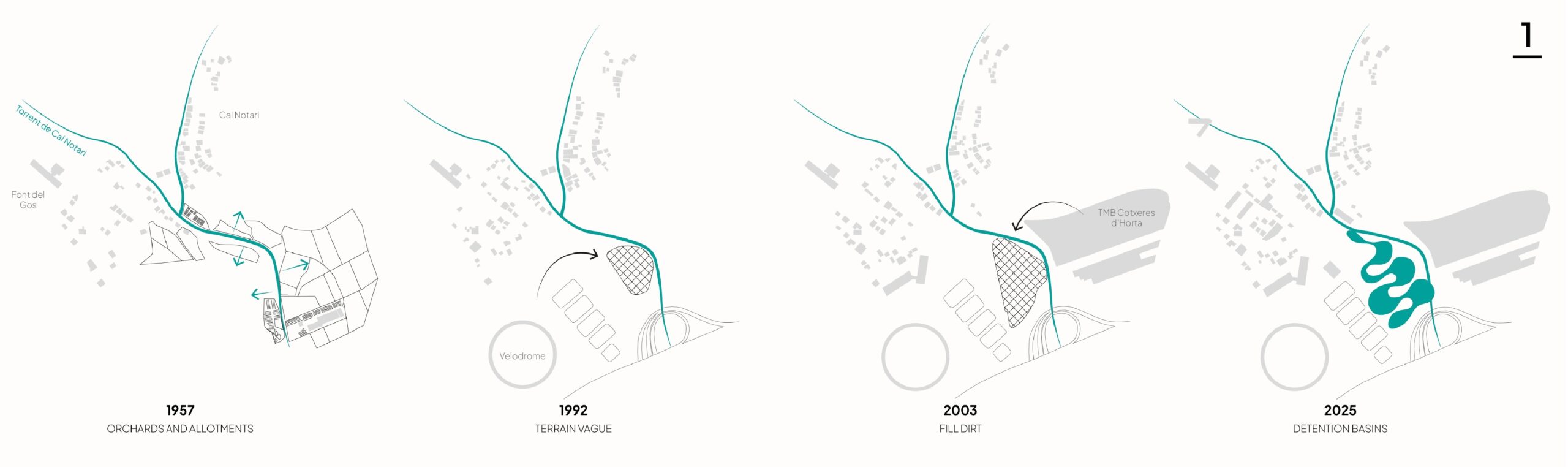
La Font del Gos is a marginalised fragment of Barcelona, suspended between the natural vitality of the Collserola mountains and the dense urban fabric of the city. Historically shaped by orchards and irrigation channels tied to the Riera d’Horta stream, the site once embodied a balance between cultivation, water, and community. This balance was lost in the late 20th century with the construction of major infrastructure — the Ronda de Dalt and the Velodrom d’Horta. The 1992 Olympic Games, though transformative for much of Barcelona, further marginalised this zone, converting it into terrain vague. Later, the excavation for Les Cotxeres d’Horta deposited layers of fill dirt over the valley, disfiguring the landscape and erasing its ecological memory.
The present proposal positions La Font del Gos as the next opportunity for city-led, regenerative urbanism — but this time, grounded explicitly in natural elements. Drawing from the theory of land autonomy, the landscape is treated not as passive ground but as a co-agent in the transformation. The natural systems that were erased — the stream, the orchards, the biodiversity — are strategically reintroduced to shape urban life and community identity.
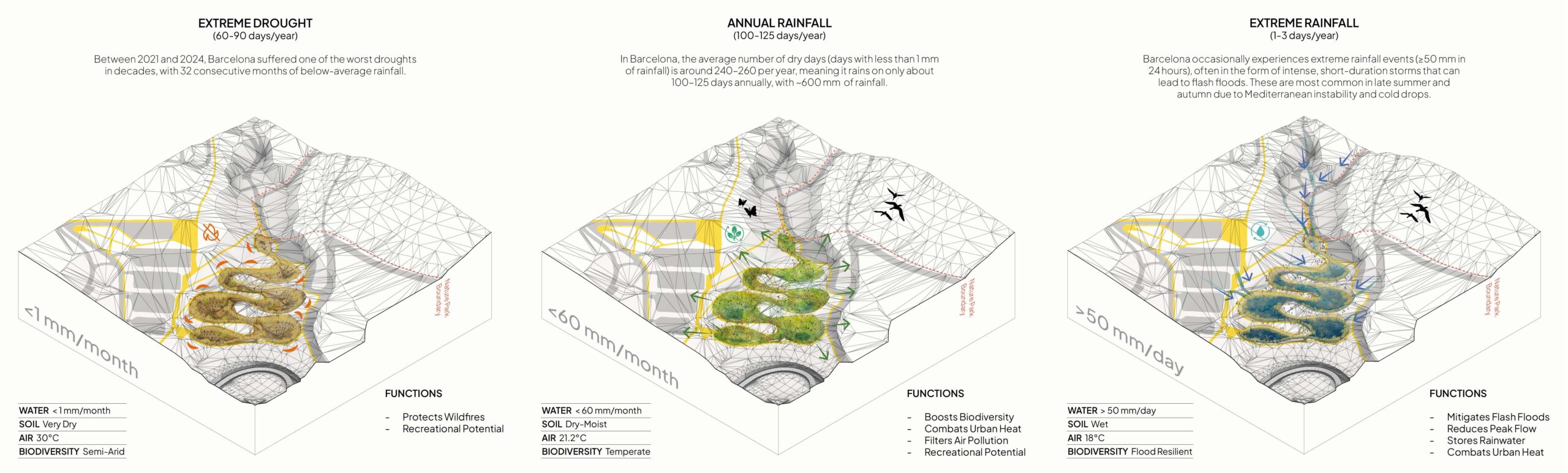
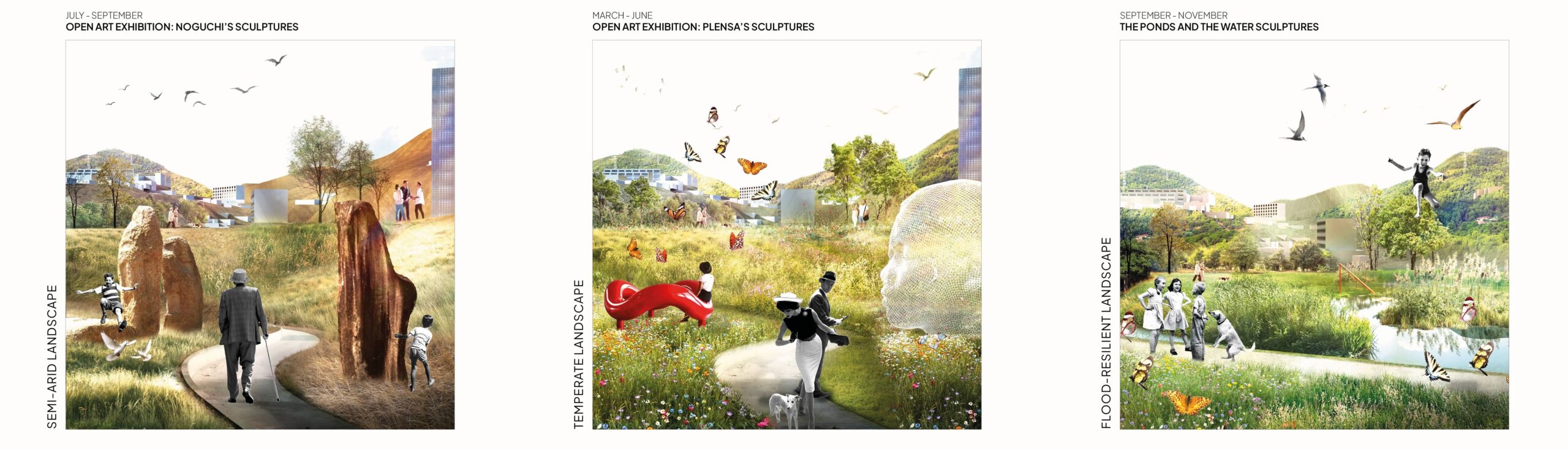
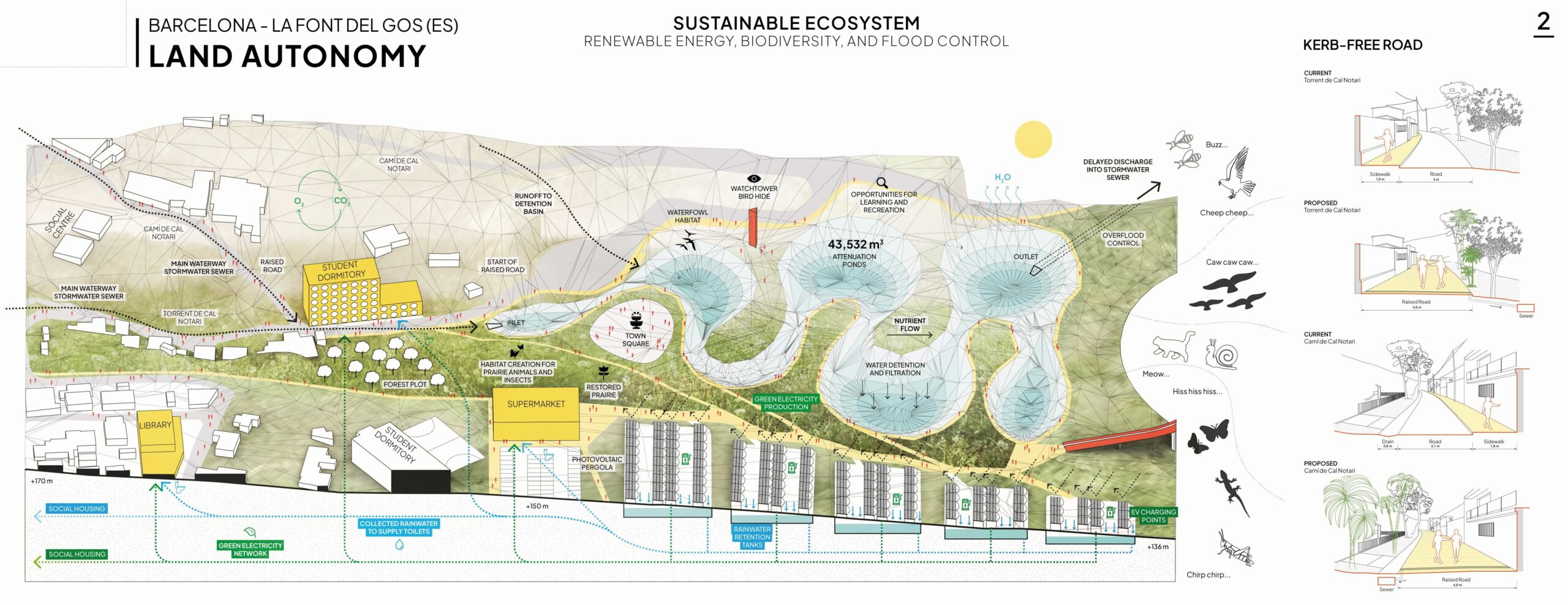
Water is brought back to the surface through a network of bioinfiltration detention basins, capturing stormwater, replenishing the soil, and mitigating floods. These ponds shift throughout the year — dry in summer, wet in storms — transforming into sunken gardens that support biodiversity and public use.
Solar energy is harvested through photovoltaic pergolas atop car parks and community spaces, powering nearby housing and infrastructure. Rainwater is collected and reused to flush toilets and irrigate green roofs. Earth becomes a living material: regraded, planted, and cultivated to restore microclimate, clean the air, and reduce maintenance through wildflower prairies. Streets are reimagined as shared, kerb-free public spaces shaded by trees and designed for pedestrians rather than vehicles.
Rather than expanding outward, this proposal demonstrates a model of repair. La Font del Gos is no longer the city’s forgotten edge. It becomes a prototype for how land, water, and people can co-produce a regenerative, resilient, and socially just urban future.
Author/credit
Architect: Jordi Ma Lu
Landscape Architect: Tianyi Jiang
Firm: TnJ Studio.
Website or social media
tianyijordi.com
Instagram: @tnj_studio @jordimalu @imjtyi